
When I began writing on these issues in 2010, I was viewed as a marginalised commentator, even in the manosphere. In 2020, many of my views on Anglo-American white women have already become mainstream. Over the past decade a veritable army of researchers have emerged who openly discuss white North American women's complicity in slavery, racism and other social malfeasance. Check out the following editorial piece from the New York Times, in which 'radical' or 'progressive' white women's complicity in institutionalised racism is openly discussed:
White Suffragist Racism
Last year, Chicago renamed a prominent downtown street for the celebrated newspaper editor and anti-lynching campaigner Ida B. Wells, who also played a starring role in the earlier 20th-century suffrage movement. Less well known in the city today is the estimable Wells contemporary Fannie Barrier Williams, a member of the black elite who had a profound impact on Chicago during more than three decades of civic and political activism.
As her biographer, Wanda Hendricks, points out, Barrier Williams broadened her influence by crossing racial lines, becoming the first black woman admitted to the Chicago Women’s Club, one of the most powerful white women’s groups in the country. She led the charge to get black women politically engaged and worked tirelessly to open the business world to them as well.
As Harper did, she dissented from the white suffrage movement’s gender-centric view of voting rights, arguing that “black women had unique needs that were defined as much by race as they were by gender and region,” making clear that she was less interested in a political candidate’s gender than in what he or she had to say about the plight of African-Americans. Beyond that, she bluntly reminded white women that racism in their ranks represented a prime obstacle for black women, writing “that the exclusion of colored women and girls from nearly all places of employment is due mostly to the meanness of American women.”
When the Suffrage Movement Sold Out to White Supremacy, Brent Staples, New York Times, Feb 2, 2020
While it might not be the Anglobitch Thesis in its purest form, the essential lines of the Thesis are present in the article quoted above. In brief, the author asserts that 'progressive' Anglo-American feminists have an uncanny knack of retaining racist and reactionary values from traditional Anglo-Saxon culture even while preaching for 'revolution' and 'change'. Although Ben Staples' focus is narrowly political, the Anglobitch Thesis demonstrates that white women's staggering hypocrisy extends into all other areas of life. For example, they retain giga-levels of sexual elitism, puritanical sex negativism and female entitlement even while marching around with placards calling for 'revolution' and the impeachment of President Trump.
In addition, Anglo feminists strive to hide their reactionary addictions behind a smoke-screen of 'genderism' - the ludicrous fiction that gender transcends all other considerations (status, wealth, ethnicity) in the Anglosphere. This conceptual trick serves to mask their own complicity in slavery and other historical crimes, not to mention contemporary racism.
In addition, Anglo feminists strive to hide their reactionary addictions behind a smoke-screen of 'genderism' - the ludicrous fiction that gender transcends all other considerations (status, wealth, ethnicity) in the Anglosphere. This conceptual trick serves to mask their own complicity in slavery and other historical crimes, not to mention contemporary racism.
In sum, white Anglo women's hypocrisy is so total that it almost defies comprehension.
Moreover, serious academic research is starting to expose the Anglo-American white woman's complicity in slavery and other evils intrinsic to Anglo-American culture. Far from being coerced into obedience by 'evil' white men, white female slave-owners were perfectly capable of performing the most evil deeds on their own account. Check out the following book review from 2019:
Equal-Opportunity Evil
A new history reveals that for female slaveholders, the business of human exploitation was just as profitable—and brutal—as it was for men.
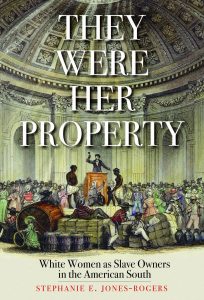
Stephanie E. Jones-Rogers opens her stunning new book, They Were Her Property: White Women as Slave Owners in the American South, with a story about Martha Gibbs, a sawmill owner in Mississippi who also owned “a significant number of slaves.” One of them, Litt Young, described her owner as a woman in total control of her financial affairs, including the management of her enslaved workers. Young remembered, for example, how Gibbs’ second husband tried and failed to convince her to stop ordering her overseer to administer “brutal whippings.” After the Confederates surrendered, Gibbs “refugeed:” She took some of her enslaved workers to Texas, at gunpoint, and forced them to labor for her until 1866—“one year after these legally free but still enslaved people ‘made her first crop.’ ” Then, writes Jones-Rogers, “Martha Gibbs finally let them go.”
Early books about female slaveholders, written in the 1970s and 1980s by historians of women’s experiences, tended to be about elite, wealthy Southerners who fell into that role when their husbands or fathers died. The women in these histories were depicted as having had a conflicted relationship with their role as slaveowner, and some historians posited that these plantation mistresses themselves were restricted and oppressed by the patriarchal society of the Old South. In this telling of history, the women who owned people didn’t directly involve themselves with the day-to-day management of enslaved workers, and certainly not with the selling and buying of the enslaved.

It’s these assumptions about female slaveowning as a kind of passive, half-hearted practice that Jones-Rogers is challenging with her book—and with them, the idea that white women were innocent bystanders to the white male practice of enslavement. Her goal, she told me in a phone interview, was to paint a picture of the way white women economically benefited from their own slaveholding. For some women, slaveholding helped them attract husbands. Within their marriages, a woman like Martha Gibbs who owned enslaved people might retain a measure of independence by maintaining control of “her” slaves. And if those husbands died, or turned out to be failures at business, their wives figured out ways to retain the human property that would ensure their continued material security.
Jones-Rogers began this shift in historical perspective by looking away from letters and diaries of elite white women that formed the documentary basis for earlier histories, and toward the testimony of the people who had been in bondage. Looking at life narratives of formerly enslaved people recorded during the Great Depression by the Works Progress Administration (Litt Young’s was one of these), Jones-Rogers found multiple instances of these witnesses naming the women who owned them—not simply as “mistresses” but as owners, with everything that entailed. She found stories of times when these women “reinforced their property claims in conversations with or in the presence of their slaves” and “challenged their male kinfolks’ alleged power to control their property, human or otherwise.”
Examining other kinds of records, Jones-Rogers found female slave-owners all over the archive of American slavery: female authors of the advertisements placed in newspapers when enslaved people ran away, identifying themselves as the runaways’ owners; women awarded compensation for the deaths of enslaved people who had been executed or sold away after being found guilty of fomenting insurrection; women compensated by cities who hired enslaved workers for public works projects. Married women, who under the legal doctrine of coverture were not commonly allowed to hold property once they had husbands, petitioned courts to gain economic rights to the enslaved people they had owned before marriage—and judges often agreed with their pleas.
The stories from WPA narratives show that from the perspective of the enslaved, female slaveholders weren’t much different from their male counterparts. Many of them were just as physically cruel as men, and they didn’t hesitate to make decisions to “sell away” enslaved people or their relatives. Stories of women who whipped enslaved people with nettleweed or fed enslaved children spoiled meat, and an entire heartbreaking chapter about the practice of separating enslaved women from their infants so that they could act as wet nurses for their mistresses’ offspring, make it clear that Southern women who owned people weren’t kind “mothers” making the best of a bad situation. “If we look carefully at slave-owning women’s management styles, we find that these differed little from those used by slaveholding men—and they rarely treated enslaved people as their children,” Jones-Rogers writes.

To some (let’s be honest, probably mostly white) people, the fact that white women have the capacity to inflict violence and to cruelly manipulate the lives of others—to be what Jones-Rogers, in our conversation, called “evil and dastardly”—is an eternal revelation. That’s why we still get curious, “look at this weird phenomenon” articles about white women at Unite the Right, or within the alt-right movement. Or why we need to be reminded again and again that white women gleefully attended lynchings, flocked in the thousands to form auxiliaries for the Ku Klux Klan, and avidly protested school integration in the South and the North. This history of slave-owning women’s economic relationship to slavery, Jones-Rogers says, should “remove the surprise.” “If you think about the value, the importance of whiteness in their lives, being a source of power, being a source of empowerment and emboldenment, then throughout history these little things make sense,” she said. “Women can hold their own when it comes to violence.”
Perhaps it’s a particularly American tic to want to believe in white women’s innocence in the cruelty of American history. Jones-Rogers reports that when she would present her work to scholars in Europe, they’d be unsurprised at its contents. “There was this kind of consensus among them that women could do these things. But when I talked to American historians, and American scholars, they were saying—‘What??? Wow!’ ”
While writing her book, Jones-Rogers read Hitler’s Furies, Wendy Lower’s history about Nazi women’s participation in genocide on the Eastern Front during World War II. “One of the arguments Lower makes is, the reason why we may be shocked is, we hold onto this hope that at least one half of humanity still has some good in it,” Jones-Rogers says. “We need some part of humanity to have this inherent, natural empathy. When we find out women can be just as vicious and atrocious, it’s very disillusioning. Because who else is left?”
Rebecca Onion, Slate, February 14, 2019
This compelling review also highlights how the pedestalising puritanism of Anglo-American culture inhibits objective assessment of white Anglo women's historical and ongoing crimes. Since European researchers were not steeped in gynocentric puritanism, they accepted Jones-Rogers' research far more readily than their North American counterparts.
While such works are worthy enough, and it is good to see the Thesis taking root in the Anglo-American mainstream, it will be noted by my long-time readers that my first book, Havok, was describing historical Anglobitch perfidy as early as 2009.
And I am still way ahead of the cultural curve. I predict that in 2030, issues like the Dogpill, Hyper-Hypergamy, Sexual False Consciousness and female child abuse will be as 'mainstream' as white Anglo-American women's historical racism is today.








 Posts
Posts


